NYC based Product Designer specializing in growth, strategy, and end-to-end solutions.

I create impactful design solutions by:

User journey visual

Understanding the user journey

Line chart data graph

Analyzing the data

Balance scale going back and forth

Balancing business goals

Moriah Bradski

👋 Hello my name is Moriah, I am a multidisciplinary product designer.
I'm a Bay Area based designer who loves solving real customer problems, moving business metrics, and delivering impactful solutions.

NYC-Based Product Designer specializing in growth, strategy, and end-to-end solutions.

User journey visual

Understanding the user journey

Line chart data graph

Analyzing the data

Balance scale going back and forth

Balancing business goals

NYC based Product Designer specializing in growth, strategy, and end-to-end solutions.
I create impactful design solutions by:

User journey visual

Understanding the user journey

Line chart data graph

Analyzing the data

Balance scale going back and forth

Balancing business goals

RTA Desktop Product Detail Page Heuristic Review
Heuristic analysis of website
NYC-Based Product Designer specializing in growth, strategy, and end-to-end solutions.

mockup of new free design help page on RTA cabinet store website
RTA Cabinet Store
Boosted lead generation by 13% through clearer communication
Reworked “Free Kitchen Design” page to communicate design process and build confidence.
Read the case study
arrow on button
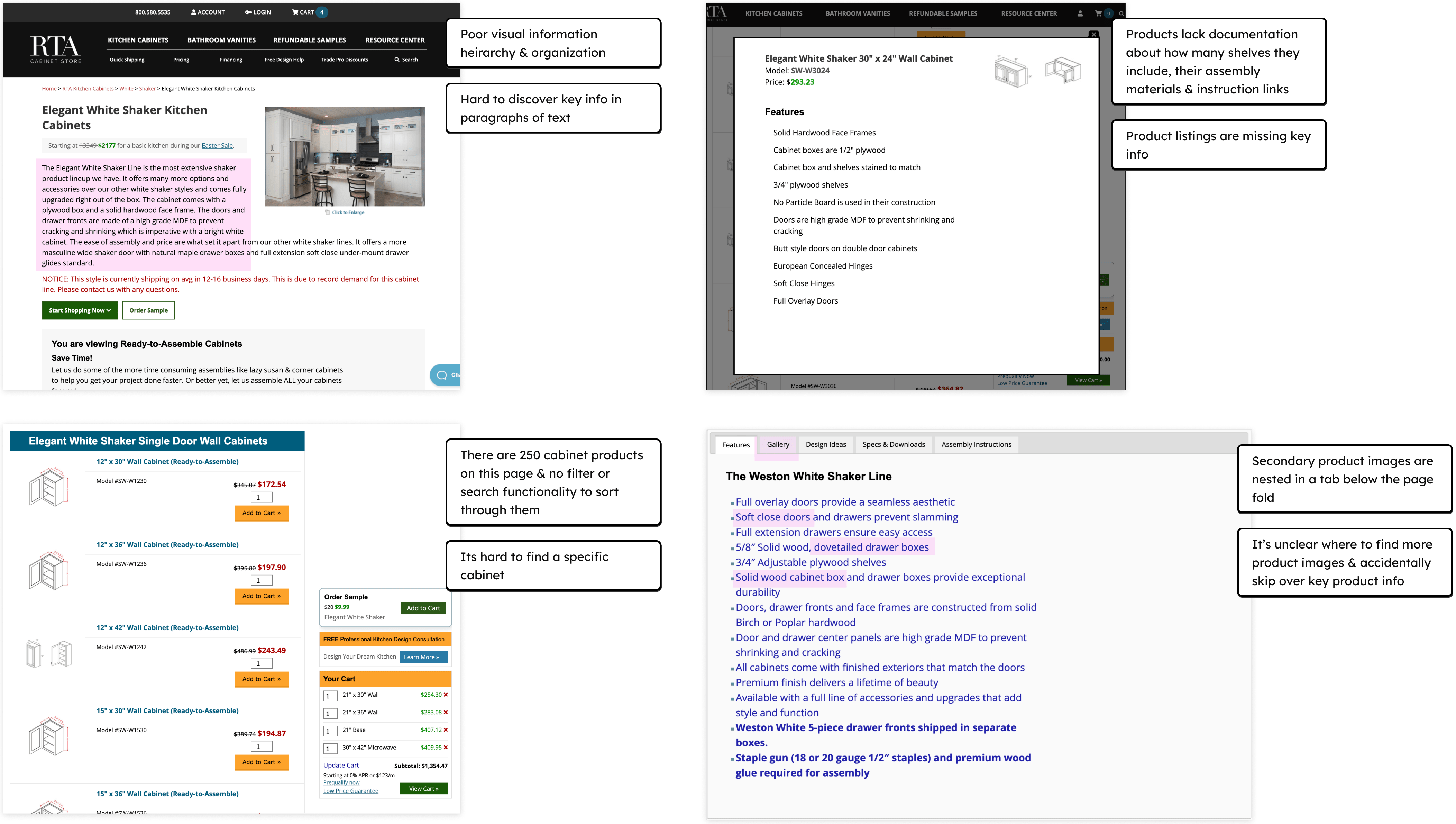
RTA Desktop Product Detail Page Heuristic Review
Heuristic analysis of website
mockup of new free design help page on RTA cabinet store website
RTA Cabinet Store
Boosted lead generation by 13% through clearer communication
Reworked “Free Kitchen Design” page to communicate design process and build confidence.
Read the case study
arrow on button
mockup of new free design help page on RTA cabinet store website
RTA Cabinet Store
Boosted lead generation by 13% through clearer communication
Reworked “Free Kitchen Design” page to communicate design process and build confidence.
Read the case study
arrow on button
Image of RTA product page on website, the new design I made
Nuts.com
Transformed the product detail page to facilitate discovery and trust, lifting conversion by 8%
Redesigned the product detail page to strengthen trust, reduce information overload and improve discovery.
view live design
arrow
Read the case study
Research Avenue 4:
Competitor Inspiration

Strategy

Retaining the Two-Page Portal Structure

I chose to retain the familiar two-page structure from the current subscription management portal to keep the user experience more similar for existing subscribers. Given that the new portal would not undergo A/B testing, I opted for a conservative approach, prioritizing familiarity and minimizing potential friction during the transition.
Before: The High-Friction User Experience
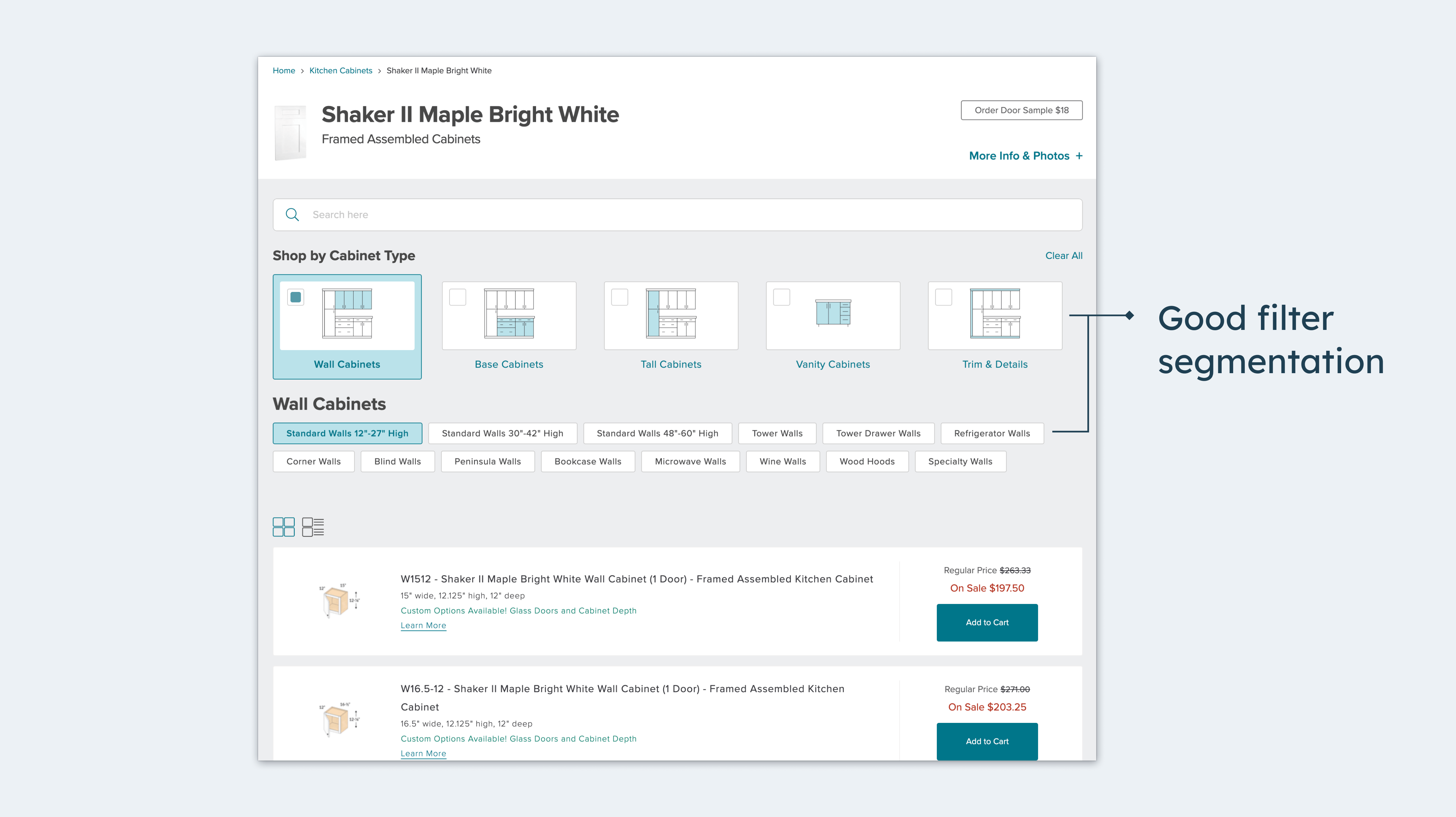
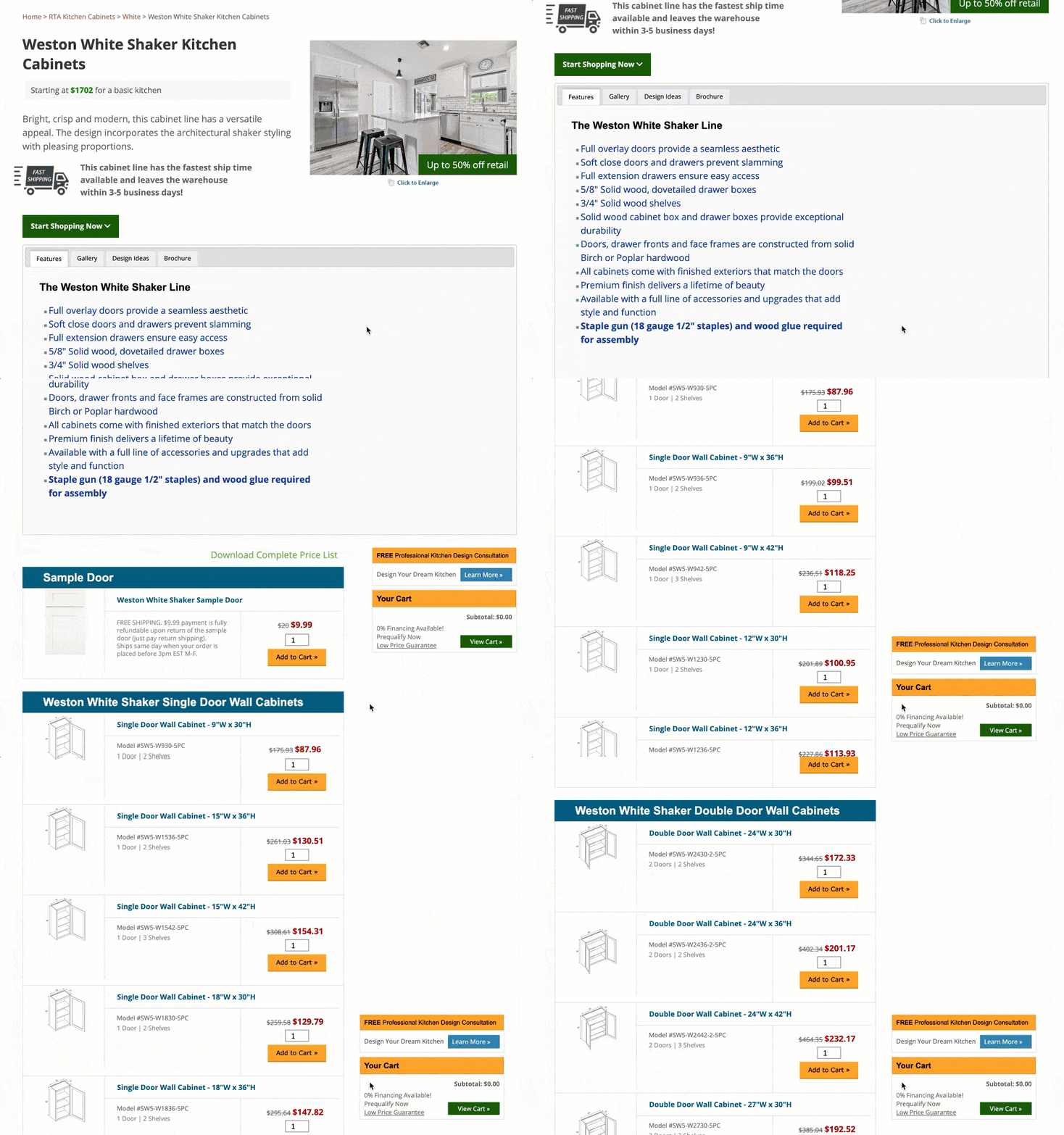
The initial state of the PDP severely hindered customer decision-making and flow. Customers would have to scroll through 250 product variations with no filters or search bar.
gif of old page design

Initiating the Project

Problem Diagnosis
Identifying the PDP as a major source of friction in the RTA journey

While reviewing support logs and listening to call recordings, I uncovered a recurring pattern: even our most high intent buyers: trade pros and homeowners, were struggling to complete their journey on the Product Detail Page. They couldn’t find the right cabinets, interpret critical specs, or make sense of pricing. The PDP wasn’t just outdated, it was actively obstructing revenue, it was also leading to high call volume.

Proposal & Buy-In
Proposing a PDP redesign to support Q4 revenue growth

I positioned the RTA PDP redesign as the highest leverage initiative within our 8-site e-commerce portfolio at Renovation Brands. While there were competing priorities across smaller brands, RTA was the highest revenue site, and the PDP was the most visited page in its funnel. It was also a top driver of support calls. Unlike other initiatives, this one had the clearest evidence of real customer pain, confirmed by support logs, call recordings, and funnel analytics. It also mapped directly to Q4 revenue goals and offered clean KPIs for impact: sample orders, product conversions, and CX burden. Prioritizing this work meant investing where both the opportunity and the urgency were clearest.

Primary KPIs:
Defining KPIs to prioritize sample orders and conversion

1. Sample Order Rate: tracking intent and engagement
2. Product Conversion Rate: measuring completed purchases
3. Design Help Sign Ups: quantifying where users still needed support

Design Challenge
Simplifying a 250+ SKU experience without losing depth

How might we restructure a 250+ SKU product detail page to reduce cognitive overload and enable high-intent shoppers, especially trade professionals and homeowners, to confidently place cabinet and sample orders?

Synthesis

Summary of current problems

My research and customer service interviews revealed four recurring pain points across user segments. These issues directly contributed to support call volume, funnel abandonment, and reduced purchase confidence.

🔎

Trouble finding specific cabinets:

Customers were forced to manually scroll through 250+ SKUs to locate the right cabinet variant. Many resorted to using browser search (Command+F) to filter the page because no search or filter tools existed.

“Customers scroll through hundreds of cabinets just to find one base cabinet in the right size.”

– Tiffany

“Trade customers will literally use Command+F on the page to find the model number”

– Amelia

“I’ve had people tell me they spent hours trying to figure out which cabinet was the right”

– Amelia

ℹ️

Important product info hidden:

Users often ask for key product information like whether a cabinet has soft close doors, dovetail drawers and what material it is made out of. Currently this information is hidden in large swaths of text and is hard to find.

“People ask daily: Do your cabinets have soft-close or dovetail drawers?”

– Emma

“A lot of people want to know what the cabinets are made of, but they can't find it easily.”

– Justin

“We get calls where the customer just wants a quick yes/no on whether a cabinet has soft-close—because it’s not obvious.”

– Tiffany

📐

Need more specific dimension details & visuals:

Most buyers relied on wireframe line drawings to understand cabinet dimensions like depth, height, and swing direction. These visual specs were often incomplete, inconsistent, or missing entirely from the product listings, forcing users to call support or abandon the page.
‍

“I get 5–10 calls a day about internal door dimensions.”

– Amelia

“People ask about drawer height, depth, and layout.”

– Justin

“We have more dimensions from vendors than we provide online.”

– Justin

🏷

Price confusion:

Customers don’t understand the base kitchen cabinet price. They think that they can get a whole kitchen for the listed price when really it's only a 10ft x10ft kitchen estimate.

“People get frustrated by the base kitchen pricing.”

– Justin

“People don’t understand that the ‘starting at’ price isn’t for a full kitchen."

– Scott

“They base decisions on the basic kitchen price and feel misled.”

– Tiffany

Initiating the Project

Problem Diagnosis
Identifying the PDP as a major source of friction in the RTA journey

While reviewing support logs and listening to call recordings, I uncovered a recurring pattern: even our most high intent buyers: trade pros and homeowners, were struggling to complete their journey on the Product Detail Page. They couldn’t find the right cabinets, interpret critical specs, or make sense of pricing. The PDP wasn’t just outdated, it was actively obstructing revenue, it was also leading to high call volume.

Proposal & Buy-In
Proposing a PDP redesign to support Q4 revenue growth

I positioned the RTA PDP redesign as the highest leverage initiative within our 8-site e-commerce portfolio at Renovation Brands. While there were competing priorities across smaller brands, RTA was the highest revenue site, and the PDP was the most visited page in its funnel. It was also a top driver of support calls. Unlike other initiatives, this one had the clearest evidence of real customer pain, confirmed by support logs, call recordings, and funnel analytics. It also mapped directly to Q4 revenue goals and offered clean KPIs for impact: sample orders, product conversions, and CX burden. Prioritizing this work meant investing where both the opportunity and the urgency were clearest.

Primary KPIs:
Defining KPIs to prioritize sample orders and conversion

1. Sample Order Rate: tracking intent and engagement
2. Product Conversion Rate: measuring completed purchases
3. Design Help Sign Ups: quantifying where users still needed support

Alignment

Getting the project approved required aligning three layers of stakeholders, each with different priorities and veto power.

Group 1:
Renovation Brands Leadership (Corporate)

To win executive support, I showed how fixing the PDP would directly support Q4 revenue goals and offered the clearest ROI due to the high volume of traffic and low cost of implementation.

Group 2:
RTA General Manager and Director of Sales (Business Stakeholders)

I positioned the redesign as a way to reduce support call volume, improve sample-to-order conversion rates, and increase qualified leads. While the GM saw the opportunity to increase sample to order conversion, sales leadership was hesitant. Their concern was that an A/B test on the PDP, a key page in lead generation, could temporarily impact performance and suppress qualified leads.
‍
To address this, I scoped a highly monitored test, backed by usability testing and collaborative design reviews with both teams. I made clear that the redesign wouldn’t reduce sales call traffic, it could actually boost it by reducing abandonment and surfacing stronger intent. Reframing the project this way helped shift the conversation from risk avoidance to opportunity cost and secured alignment across both groups.

Group 3:
RTA Dedicated Dev Team (Engineering Capacity Owner)

I earned engineering buy-in by showing how the PDP’s UX issues were driving real user friction. Once aligned on the problem, we scoped the redesign together to keep effort reasonable, avoiding backend changes while modernizing layout, breakpoints, and reusable styling.

mockup of new free design help page on RTA cabinet store website
RTA Cabinet Store
Boosted lead generation by 13% through clearer communication
Reworked “Free Kitchen Design” page to communicate design process and build confidence.
Read the case study
arrow on button
🚀 PROJECT LAUNCHED
🧪 Round 1:
In-Office Guerrilla Testing (Low-Fi Wireframes)
First, I conducted in-office usability testing with low-fidelity wireframes. These informal sessions helped me quickly validate the design’s basic structure and core interactions.
‍
• Version: Interactive Low-Fidelity Mobile Wireframe (Figma)
• Method: In-person, rapid testing with co-workers
• Participants: 5